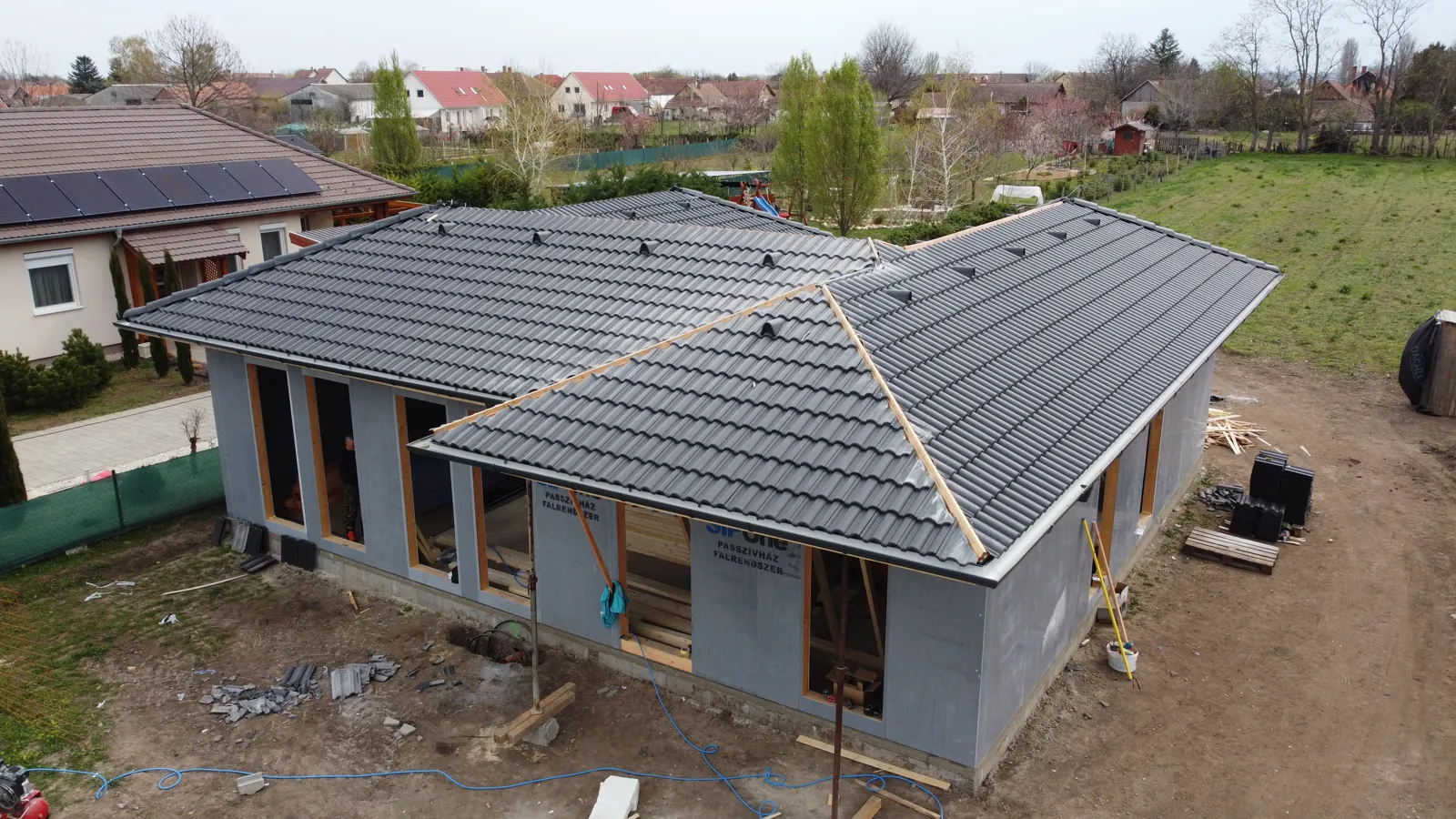
What Happens to a SIP House After 20 Years?
Component by component, we walk through what happens to a SIP house built today over the next 20 years – including what will need replacing.
You are not really buying a house. You are looking for the answer to one question: "Will my money be safe?" It is a fair question – a family house is most families' largest asset. So this is not a brochure but a forecast: component by component, we go through what happens to a SIP house built today over 20 years. Some of it will need replacing – we will say so.
Key takeaways
- The structure (MgO board + EPS core) does not degrade over 20 years: there is no wood in it, it does not rot, rust or burn.
- Insulation performance is not a wear part – the house's U-values will be the same in 2046.
- What will need replacing: the building services (heat pump, hot-water tank, ventilation unit) – exactly as in any modern house, whatever the wall material.
- Maintenance is a routine of a few hours a year, and also a condition of the warranty.
- Value retention rests on three things: running costs, condition and paperwork – a documented house remains accessible to the entire buyer market.
The structure: 20 years is nothing
The skeleton of a SIP panel – MgO boards with an EPS core bonded between them – contains no material that degrades on a 20-year horizon:
- EPS insulation does not "wear out". Insulating performance does not fade with the years; EPS is a stable material with decades of installed experience, which does not rot and does not feed any organism.
- MgO board is a mineral material: it does not rot, does not rust, nothing eats it, and it is non-combustible. There is no wood in the wall, so there is nothing to fear from moisture the way there is in a timber-frame or OSB structure.
- The sandwich-panel principle has been proving itself for 90 years: the first experimental panel houses were built in the 1930s, and decades of observation have validated the concept. Today's certified systems have an expected lifespan of 60–100 years – so 20 years is the first quarter of the journey.
There is one condition, and we will not hide it: all of this applies to a properly built house. The airtightness of the joints and the integrity of the claddings are what deliver the lifespan – which is why every house we build uses a documented system technology, and why you receive a maintenance guide at handover.
Insulation and thermal performance: what will you measure in 2046?
The house's U-values remain practically unchanged – insulation performance is a structural property, not a wear part. What does change: the requirements get stricter. The EU is moving towards zero-emission buildings by the end of the decade; a house at A++ level today will still be in the upper band of the housing stock in 20 years – unlike a "just compliant" minimum house built today, which by 2046 will slide into the lower half of the market. This is one of the hardest, most quantifiable factors in value retention.
Moisture: the critical question, honestly
The long-term fate of every lightweight house depends on moisture management. What do we know on a 20-year horizon?
- Against water from outside, the facade system and the roof protect the house – their maintenance (see below) is your one- or two-hour job each year.
- Against humidity from inside, the factory airtightness of the joints and the ventilation protect it. With heat-recovery ventilation the question is closed; without it, regular airing is the occupants' job – just as in any new, well-sealed house, brick included.
- If water damage does occur (burst pipe, leak): MgO board does not swell or rot, and the structure can be restored after drying – a fundamental difference from conventional OSB-faced SIP, where soaking can destroy the sheathing.
The timber elements
There is no wood in the wall panels. Wood may be present in the roof structure (nail-plate trusses) – treated timber in indoor, dry conditions, with a design life equal to that of the house. The 20-year task: an annual visual check of the roof space (signs of leaks, insects) – recommended for every house, whatever the technology.
Fixings and connections
The mechanical fixings and adhesive bonds of the panel connections age together with the structure – meaning no meaningful degradation over 20 years. Everyday fixings on the facade and internal walls (shelves, cabinets) are part of normal home use. Worth knowing: for any later alteration (enlarging openings, extensions) the system provider's involvement is a condition of the warranty – this is recorded in the documentation.
Building services: here you will have work – as in every house
An honest list of what will definitely cost money over 20 years – with the emphasis that this is not a SIP peculiarity but the life cycle of every modern house that relies on building services:
| Equipment | Expected lifespan | Task over 20 years |
|---|---|---|
| Air-to-water heat pump | 15–20 years | 1 replacement likely around year 15–20; annual service until then |
| Hot-water tank | 10–15 years | typically 1 replacement (depends on water quality); anode replacement in between |
| Heat-recovery ventilation unit | 15–20 years | filter change twice a year, fan/unit replacement at end of cycle |
| Underfloor heating pipework | 50 years | nothing – the pipes are designed for the life of the house |
| Window and door hardware | 15–25 years | adjustment, seal replacement; the glazing stays |
| Paint, floor and wall finishes | as taste dictates | renovation as desired – as anywhere |
| Facade render | 25–40 years | wash/repaint around year 15–25 |
The overall picture: the cost of renewing building services over a 20-year cycle is roughly the same as for any new house with the same equipment – regardless of the wall material. Where SIP differs: you do not need to spend on the structure itself.
Maintenance: the annual routine
The essence of the maintenance guide you receive at handover fits in five points: annual gutter cleaning and roof inspection; visual check of the facade (cracks, plinth damage); ventilation filter changes; building-services service; every 5 years, window and door adjustment and seal check. That is less than an old house with a chimney, gas and a tendency to damp demands – and it is a condition of the warranty.
And the value? The question behind all the others
In 20 years your house will compete on the market on three things: running costs, condition and paperwork.
- Running costs: A++ energy performance will still mean the top band in 2046 – exposure to energy prices is an ever stronger pricing factor in the housing market.
- Condition: a SIP house maintained as described above is structurally at the start of its life.
- Paperwork: the handover documentation (certifications, drawings, warranties, maintenance log) is the great differentiator on the used lightweight-house market – a documented house can be bought with a mortgage and state subsidies, so the entire buyer market is reachable.
The share of lightweight construction in Hungary has quintupled in five years, and today one in five new family houses is built this way; in Western Europe the share has long been 45–70%. Judging by the direction of the trend, in 20 years nobody will need to explain why their house is lightweight – but owners of poorly insulated houses will have to explain why theirs is not.
So the answer to the unspoken question: yes – in a SIP house built with a certified system, with full documentation and normal maintenance, your money is at least as safe as in any other technology. And along the way you pay less for heating for 20 years.
Would you like to see the completed houses this article is based on? Browse our references, read about how we build houses – or ask us in person.
Frequently asked questions
What is the lifespan of a SIP house?
Today's certified systems have an expected lifespan of 60–100 years when built properly. The sandwich-panel principle has been proving itself for 90 years, since the 1930s – so 20 years is the first quarter of the journey, not the end.
What will need replacing in a SIP house within 20 years?
The building services: the heat pump and ventilation unit reach the end of their life at around 15–20 years, the hot-water tank at 10–15, and window hardware needs adjustment and new seals. This is true of every modern house – but there is nothing to spend on the structure itself.
What happens if a SIP house suffers a leak or a burst pipe?
MgO board does not swell or rot, and the structure can be restored after drying. This is a fundamental difference from conventional OSB-faced SIP, where soaking can destroy the sheathing.
Request a no-obligation quote
On-site survey, itemised cost estimate, fixed deadline and warranty – we reply within 1 business day.
- Reply within 1 business day
- Itemised cost estimate
- Fixed price, fixed deadline, warranty
Related articles
Disadvantages of SIP Houses: An Honest List
Odd for a SIP builder to write about its own technology's weaknesses? We don't think so. Here is everything worth knowing before you build, and what we do about each point.
Read more →
10 Myths About Lightweight Houses, Debunked
Everyone in Hungary has an opinion about lightweight construction, including people who have never set foot in one. We go through the ten most common myths and say where each has a grain of truth.
Read more →
Financing a SIP House in Hungary: Loans 2026
Yes, a certified SIP house qualifies for Otthon Start, CSOK Plusz and rural CSOK. We explain the Hungarian schemes and how bank disbursement works during construction.
Read more →