Why SIP? Why TeleHome? Honest Answers
Anyone thinking about building a family house asks the same eight to ten questions when they first meet SIP technology. We answer them here – without hedging, with numbers, and with the nuances where the answer is more nuanced.
Anyone thinking about building a family house finds the same eight to ten questions forming in their mind when they first come across SIP technology. On this page we answer them – without hedging, with numbers, and, where the answer is more nuanced, with the nuances too.
Why SIP and not brick?
Not because brick is bad. Brick is a proven, durable technology – but even brick can only meet the requirements of today's nearly zero-energy house (at least energy class "A", a total energy demand of no more than 76 kWh/m²/year) with thick thermal insulation. A modern brick wall, including insulation and renders, is typically 42–48 cm thick. The MgO-faced SIP wall structure with a graphite EPS core that we build delivers the same – in fact a better – insulation value from about 30 cm.
This shows up tangibly in three things:
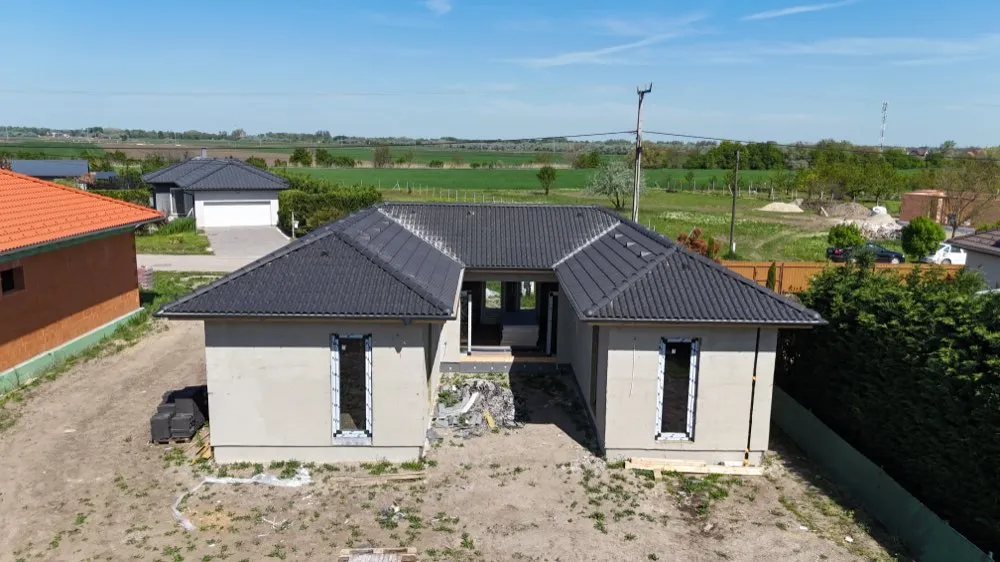
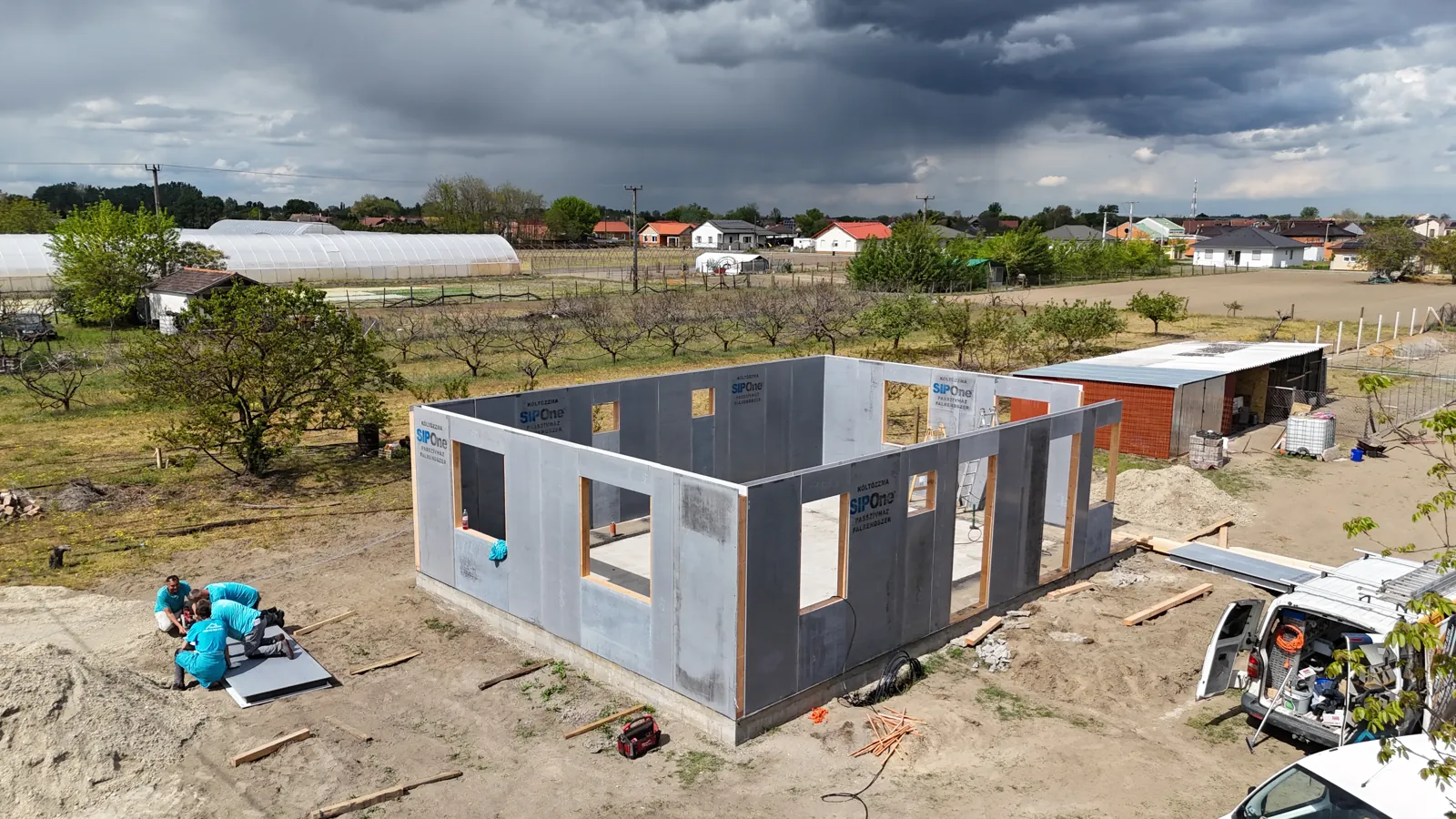
Time. SIP panels are made in a factory, to exact dimensions, and on site the structure stands in days. There is no bricklaying and no months-long drying time. Turnkey handover typically takes 4–6 months – with masonry technology in Hungary a duration of 1–2 years is not uncommon.
Usable floor area. Because of the thinner wall, the same built footprint yields roughly 5–7 m² more usable area on a 100 m² house. That is the difference of an entire child's bedroom – for free.
Running costs. The thermal-bridge-free, airtight structure, combined with a heat pump and underfloor heating, reduces the heating cost to a fraction of that of an average Hungarian house (the average of the Hungarian residential building stock is approx. 200 kWh/m²/year – a modern SIP house uses a quarter to a fifth of that).
Why SIP and not Ytong?
Aerated concrete (Ytong) is a likeable technology: it is easy to work with, and even as a single-leaf wall it can provide good thermal insulation. But that takes a very thick wall: Ytong walls with really good insulation are 37.5–50 cm thick, and even so their best value (U = 0.17–0.22 W/m²K) falls short of what the SIP build-up achieves from 30 cm. Ytong is also a wet technology: bricklaying, plastering, drying times – the build is months longer. The floor-area advantage gained from the thinner wall is even greater against Ytong than against brick.
Why choose us?
We answer this question not with slogans but with verifiable facts:
- Certified system. The SIP system we use has ÉMI certification for wall and roof structures, as well as a European Technical Assessment (EOTA/ETA). This is not a marketing trick: without these documents there is no declaration of performance, and the banks do not accept the house as collateral either. We present every document on request – see our Document library page.
- Hungarian manufacturing partner. Our panels are made by our contracted manufacturing partner, KöltözzMa Kft., in Hungary, in its own plant. We do not work with panels of unknown origin arriving in a container: manufacturing is documented, takes place under factory production control, and the MgO boards built in are made with chloride-free technology.
- General contracting from a single source. From design to handover of the keys there is one contract and one responsible party. No finger-pointing between the trades.
- Transparent technical specification. For each of our house types we set out item by item what the price includes – and what it does not. This way our quote can genuinely be compared with others'.
Is it really cheaper?
An honest answer: turnkey prices per square metre in Hungary today move in roughly the same band regardless of technology (in 2025–26 approx. HUF 500–620 thousand/m² at turnkey level). SIP is not a "miracle house built at half price" – beware of anyone who promises that.
Where SIP is genuinely, demonstrably cheaper:
- Time = money. You move in within 4–6 months, not 1–2 years. You save the overlapping months of rent/loan, and the rise in construction prices during the year affects you less.
- A smaller heating bill, for decades. The difference can be several hundred thousand forints a year compared with a house in average condition.
- More usable m² from the same built footprint. If you calculate in price per square metre, this alone is a 3–5% "price advantage".
- A more predictable budget. Thanks to factory manufacturing and the fixed technology there are fewer surprises during construction.
Is it really faster?
Yes, and this follows from the nature of the technology, not from clever organisation. The panels are made on the production line while the foundations are being built on the plot – the two workflows run in parallel. On site there is no wet trade in the walls, so there is no curing or drying time, and the weather is far less able to hold up the work. The structure stands in days to weeks, and the complete house is typically turnkey in 4–6 months.
How long does a SIP house last?
Sandwich-panel construction is nothing new: the first experimental panel houses were built by the US Forest Products Laboratory in 1935 and monitored for decades; foam-core SIP has existed since 1952. According to international experience, the lifespan of a properly built and normally maintained SIP house is 60–100 years, i.e. equivalent to conventional construction.
Two things are worth knowing. First: with every lightweight system the key to lifespan is the airtightness of the junctions and the maintenance of the claddings – which is why we work with certified system technology and a documented construction procedure. Second: the MgO-faced panel also differs from conventional OSB SIP in that there is no wood in the wall that could rot: magnesium oxide board does not go mouldy, does not feed fungi and is non-combustible.
What happens if I want to sell it in 10–20 years?
That is a fair question, and the keyword of the answer is documentation. On the market for used lightweight houses a price discount really does exist – but it mainly hits the "DIY" houses without papers, built with unknown technology. A house built with an ÉMI/ETA-certified system and documented with a declaration of performance, drawings and a warranty is accepted as bank collateral and can also be bought with state support (CSOK Plusz, Otthon Start) – so its pool of buyers is the same as that of a brick house.
What is more, the direction of the market works in favour of lightweight construction: according to Duna House data, in 2021 about 3% of new family houses were built with lightweight construction, by 2026 this share had grown to above 20%, and today two in ten people building a house are specifically looking for one. In Western Europe the share is 45–70%, in Scandinavia above 60–70%. In an age of energy prices, the value of a house with A++ energy performance and low running costs is not in question.
We hand over a complete documentation package with every house – this is the "service book" of your property, and it is worth gold when you sell.
Will the bank finance it?
Yes. Hungarian banks accept a lightweight residential building as collateral and lend on it, provided the system has the necessary technical assessment (NMÉ/ÉMI or ETA) and a declaration of performance – our system has exactly these. A market-rate mortgage, the fixed 3% loan of the Otthon Start Programme, CSOK Plusz, rural CSOK and the Babaváró loan are all available for it, subject to the eligibility conditions in force at the time. The bank disburses the construction loan in stages, according to the degree of completion – we present this process step by step on our "Financing a SIP house" page, and we also help with the bank paperwork.
Can it be insured?
Yes. According to a survey by MABISZ (the Association of Hungarian Insurance Companies), Hungarian insurers do write home insurance for lightweight houses; several companies make no distinction at all compared with conventional construction. When taking out insurance, the wall type has to be stated precisely – we help with this too. A particular advantage of the MgO panel system is that the wall structure is made of non-combustible material (fire class A1–A2), which is favourable when the fire risk is assessed.
How well does it hold its value?
Value retention is determined by three factors: energy quality, documentation and demand. All three speak for the certified SIP house: the A++ energy level also meets the requirements that will tighten in the future (from 2028–2030 the EU is moving towards zero-emission buildings), the complete technical documentation provides bank financeability and buyer confidence, and demand for lightweight houses is growing year by year. What really erodes the value of a house – high running costs, damp, undocumented alterations – is here either ruled out by the technology or handled by the system warranty and the maintenance guide.
What happens if there is a warranty problem?
One contract, one responsible party: general contracting means that in a warranty matter you do not have to arbitrate between contractors – you turn to us, and we take action. The structure is covered by the manufacturer's system warranty, and the construction works by the statutory mandatory fitness-for-purpose and guarantee periods and by our own commitments; we hand over their exact conditions in writing, as an annex to the contract, and they can also be downloaded from the Document library. When a defect is reported, we hold an on-site inspection within a fixed deadline and record the method and the deadline of the repair in writing.
Request a no-obligation quote
On-site survey, itemised cost estimate, fixed deadline and warranty – we reply within 1 business day.
- Reply within 1 business day
- Itemised cost estimate
- Fixed price, fixed deadline, warranty
Related articles
Disadvantages of SIP Houses: An Honest List
Odd for a SIP builder to write about its own technology's weaknesses? We don't think so. Here is everything worth knowing before you build, and what we do about each point.
Read more →
10 Myths About Lightweight Houses, Debunked
Everyone in Hungary has an opinion about lightweight construction, including people who have never set foot in one. We go through the ten most common myths and say where each has a grain of truth.
Read more →
Financing a SIP House in Hungary: Loans 2026
Yes, a certified SIP house qualifies for Otthon Start, CSOK Plusz and rural CSOK. We explain the Hungarian schemes and how bank disbursement works during construction.
Read more →